Tracking and consent
How Promoosh measures purchases, what happens when a visitor declines, and the three Meta modes.
How purchases are measured
Promoosh adds a Web Pixel to your Shopify store. It captures events in the store, including purchases, and sends them to Promoosh. The Tracking module shows whether the pixel works, and has the tabs Overview, Events & funnel, Forwarding and Geography.
Tracking fills, among other things, the Channel column in Orders Overview and the Meta part of POAS.
Consent
The pixel follows Shopify's consent mechanism. When a visitor declines:
- If Consent signal (modeled conversions) is on for the store, one anonymous signal without personal data is stored: no click ID, cookies, IP address, visitor ID, URL, referrer or value.
- If it is off, nothing from that visitor is stored or forwarded.
The consent signal is activated in your Shopify theme. The checklist item “Activate Consent Signal in theme” takes you there.
Meta tracking: three modes
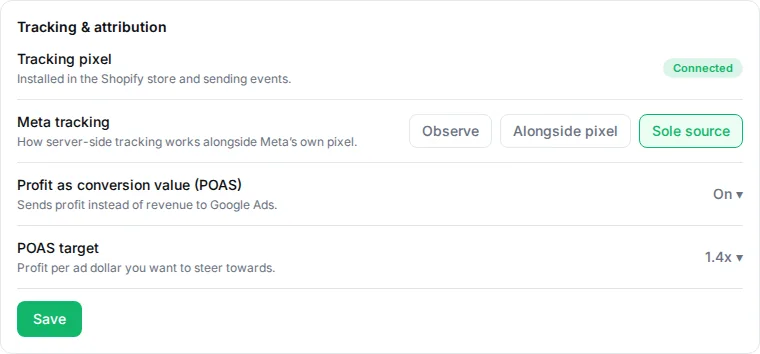
Under Settings → Tracking & attribution you choose how Promoosh relates to Meta's own purchase measurement:
- Observer — Promoosh never sends a conversion to Meta. POAS and profit are only shown in Promoosh.
- Coexist (default) — Promoosh sends purchase data server-side as an addition to Meta's own pixel, never as a replacement.
- Promoosh owns the measurement alone — Promoosh becomes the only source of Meta purchases. This requires you to turn off Shopify's own data sharing with Meta; the app shows exactly where.
Revenue or profit as the conversion value
Under Profit-based bidding (POAS) you choose per platform whether Promoosh sends revenue or profit as the conversion value. With profit, Google and Meta optimise bidding for profit instead of revenue. This requires your products to have a cost in Shopify — see Cost prices and fallback cost.
Forwarding to Google and Meta
When forwarding is enabled for your account, purchases are sent server-to-server to the Meta Conversions API and Google Enhanced Conversions, only for purchases with consent. Email and phone are normalised and hashed with SHA-256 before they are sent; plain text never leaves Promoosh. More in Data and privacy.
Last reviewed 30 October 2026